
Deepfake Labels Fail When Platforms Crop the Frame
A disclosure added at upload may vanish when a synthetic video is downloaded, clipped, or reposted. Test the exported file, not just the original post.
September 16, 2026 · 8 min read
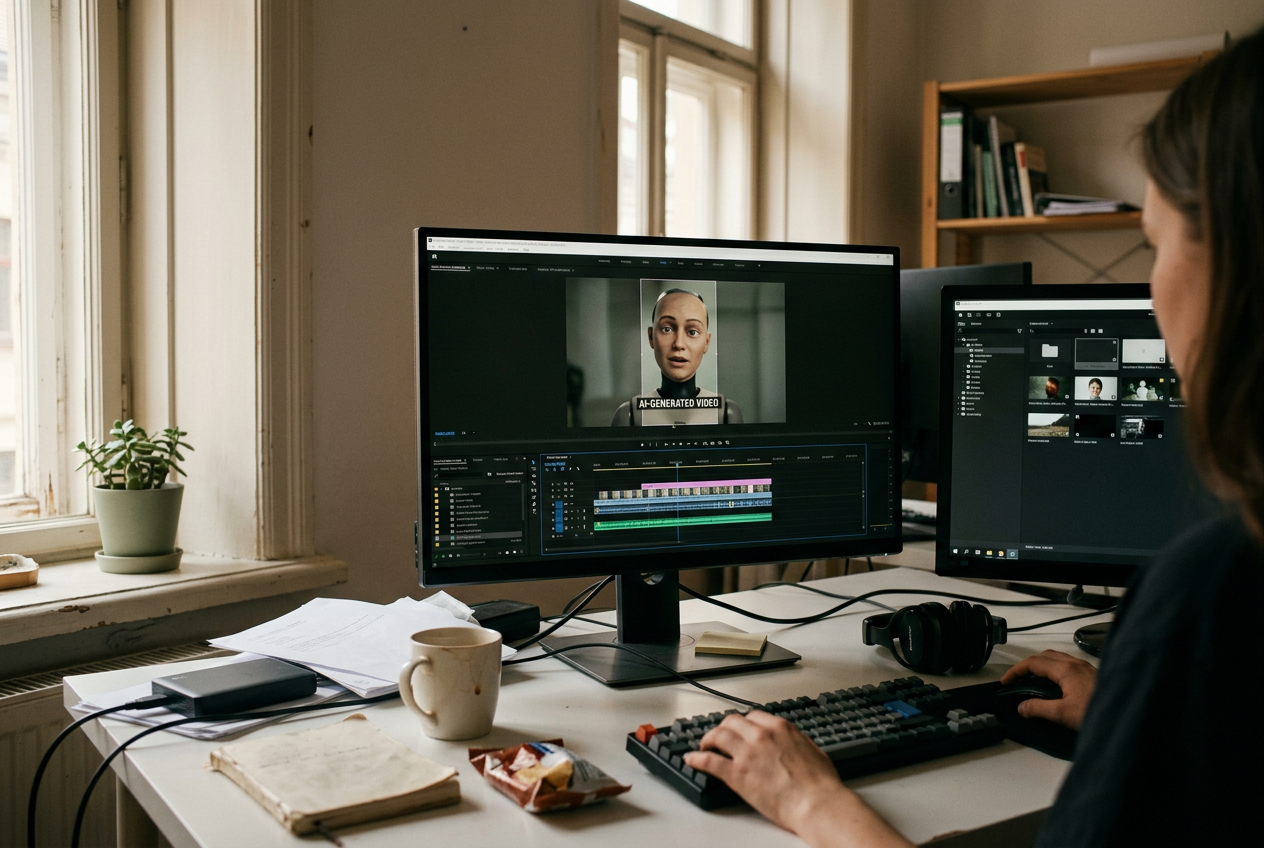
The test case is a 16:9 video of a synthetic speaker, prepared for a campaign that expects the clip to circulate through social feeds, messaging apps, downloads, and vertical reposts. The production master contains a short disclosure near the lower-left corner, a longer explanation on its opening slate, and provenance data in the file.
All three disclosures work in the master. They do not fail together.
A vertical crop removes the corner label. Trimming the opening seconds removes the slate. Exporting or screen-recording the post can separate the pixels from the provenance data, while platform recompression, which decodes and encodes the video again at different settings, makes small lettering harder to read. The disclosure looked adequate on the editing timeline because that was the least hostile version of the file.
For this evaluation, the controlling requirement was written as a testable internal specification:
“The disclosure must remain visible and readable throughout any published excerpt after ordinary platform cropping and recompression.”
That sentence is an acceptance criterion, not a quotation from a law or platform policy. Applicable requirements vary by jurisdiction, content, advertiser status, and service, and some rules specify a disclosure without prescribing its exact placement or persistence. This walkthrough tests whether a label travels with the content. It is not legal advice.
Start with the copy, not the codec
Use wording that identifies the relevant fact without requiring the viewer to infer it. “AI-generated video” is compact and direct when the whole scene is synthetic. If authentic footage has only an altered voice or face, narrower wording such as “AI-altered voice” or “AI-altered video” may communicate more accurately.
“Made with AI” is weaker. It could refer to captioning, color correction, or a synthetic person, and that ambiguity matters when the disclosure concerns fabricated speech or appearance. “Deepfake” is widely recognized but inconsistently understood, so it can appear in supporting copy while the visible label states what was changed.
The synthetic-speaker clip used two layers of wording. A persistent label said “AI-generated video.” The opening disclosure supplied the fuller statement: “The depicted speech and appearance are synthetic.” The longer sentence carried meaning, but it occupied too much of the frame to remain on screen throughout the video without competing with captions and the subject.
Do not shrink the persistent label until it fits. Recompression discards image detail, especially around sharp letter edges and in areas with motion, texture, or low contrast. A short label rendered at a readable size survives better than a complete explanation reduced to fine print.
Put the persistent label where cropping cannot quietly remove it
The lower-left label failed first. It survived a standard landscape upload, then disappeared when the same clip was reframed around the speaker for a vertical feed. Nothing malfunctioned. The crop did exactly what it was supposed to do: retain the central subject and discard the sides.
Move the essential label into the central region that an editor or automated crop is likely to preserve. On the test clip, that meant placing it above the speaker’s chest rather than against an outside corner, with enough inset that modest top and bottom trimming did not touch it. The precise location must follow the composition; the useful rule is to place the label near content that cannot be cropped out without making the clip itself unusable.
That creates a production tradeoff. A center-safe label, meaning one kept within the portion shared by common aspect-ratio crops, is more intrusive than a corner watermark. It can overlap a face, captions, a lectern, or product detail. The fix is not to send it back to the edge.
Adjust the shot, move captions, add a solid backing panel, or create separate landscape and portrait masters with the disclosure positioned for each composition.
Interface overlays introduce another failure. Social apps place account names, captions, controls, and engagement buttons over different parts of the image, and those elements can change between viewing modes. Review a posted test on a phone with the normal controls visible. The clean preview in an editing application does not show the frame the audience receives.
Burn the label into the rendered frames
A burned-in label becomes part of the image pixels during export. It normally survives transcoding, which is the conversion from one compressed video representation to another, because the platform treats the text as picture content rather than optional descriptive data.
“Normally” needs a boundary. Recompression can blur thin strokes, crush a translucent background into nearby colors, or make lettering shimmer as the encoder allocates fewer bits to the frame. Cropping can still remove burned-in text. An automatic cleanup tool can deliberately erase it.
Burning in a label protects against routine processing, not adversarial removal.
The test label held up best with high contrast, a plain typeface, a solid or nearly solid backing shape, and padding around the words. Fine outlines and low-opacity boxes looked less disruptive in the master but lost separation from the moving background after another export. Styling should be judged from the recompressed copy at normal viewing size, not from a paused full-resolution frame.
Keep the disclosure present across every frame covered by the requirement. An opening card is useful context, but a user can clip it off without editing the represented event. A closing card is even easier to lose. Repeating a label intermittently reduces obstruction, yet it also creates undisclosed frames that can become standalone screenshots or short clips.
For the synthetic speaker, the fallback was a persistent short label plus fuller language at the start and in the accompanying post. That combination preserved the minimum fact in the pixels while leaving room elsewhere for scope, creator identity, and provenance details.
Treat metadata as evidence, not the visible notice
File metadata stores information alongside the audiovisual stream rather than drawing it into the picture. Basic container fields can identify an author, editing application, description, or copyright status, but upload services frequently rewrite the container and may omit fields they do not use.
Content Credentials based on the C2PA technical standard can attach cryptographically signed provenance assertions, allowing compatible software to check claims about a file’s origin and edits. That is more useful for verification than an unsigned text field. It still does not guarantee that a disclosure appears to a viewer, and a crop, screen recording, or fresh export can produce a derivative that lacks the original manifest unless the workflow preserves or re-establishes the connection.
Keep provenance where the publishing path supports it. Inspect the downloaded result rather than assuming the upload retained it. Metadata should answer deeper questions for compatible tools and investigators; the burned-in label should carry the fact a person needs while watching.
The platform’s own synthetic-media control belongs in the same layered approach. When a service offers an uploader disclosure setting, switch it on and inspect the live post. The resulting badge or context panel may be enforced within that service’s interface, but it should not be presumed to remain attached to a downloaded file, an embedded player, or a repost elsewhere. Platform enforcement and portable disclosure are separate properties.
Run the clip through the path an audience will use
Begin with one approved master and record its checksum, a compact value used to detect whether a file changed, so reviewers do not confuse later derivatives with the source. Save a reference frame showing the persistent label, and keep the disclosure wording in the production log.
Upload the master through the normal account and publishing workflow. Do not stop at the creator preview. View the public result on a phone, allow the application interface to cover the frame, enable captions, and inspect scenes where the label crosses both light and dark backgrounds.
Next, obtain the platform-generated copy if the service provides a download route. Compare the visible label with the master at ordinary playback size. Check whether letter interiors have filled in, whether the backing panel has developed blocky edges, and whether the label remains readable during motion rather than only while paused. Inspect the file for the metadata or provenance assertions that were present before upload.
Then make the likely derivatives. Create a central vertical crop, trim away the opening disclosure, take a short excerpt from the middle, and pass the result through another ordinary export. A screen recording is worth testing because it captures what appeared on the display while leaving the original file structure behind. Messaging-app forwarding should enter the matrix when it is a plausible distribution route, since that adds another opportunity for resizing or encoding.
Record each output as pass, conditional pass, or fail against the quoted requirement. A label that survives only in landscape is a conditional pass if portrait reuse is expected. Metadata that remains verifiable but has no visible user-facing indication passes a provenance check and fails the disclosure check. Keeping those judgments separate prevents a technically interesting credential from being mistaken for a notice people can see.
The synthetic-speaker clip should not ship from this workflow until the middle excerpt, vertical crop, and recompressed download all retain readable wording. If a required platform format cannot preserve the label without covering essential content, produce a format-specific edit. If that still fails, the operational fallback is to withhold that distribution variant, not to assume the post caption will travel with a detached video.
Keep receipts for the published derivative
Archive the approved master, the exact uploaded file, screenshots of the live disclosure, and representative downloaded derivatives. Save the wording decision and the test result beside them. A link to the post is insufficient because interfaces, labels, and availability can change.
This record does not prove that nobody removed the disclosure later. It shows what the publisher attached, what the platform displayed during the check, and which transformations the team tested. That distinction matters during an audit: the production team can support claims about its own controls, while avoiding a broader claim that every downstream copy stayed intact.
Questions people ask
Is metadata enough to disclose a deepfake?
No. Metadata can support provenance and later verification, especially when compatible tools can validate signed assertions, but viewers may never see it and platforms may remove it during export. Use metadata as an evidence layer alongside a visible, burned-in disclosure.
Where should a deepfake label appear on the video?
Place the essential label inside the region likely to remain after landscape-to-portrait cropping, near visual content that an editor must preserve. Test the live post for interface overlays, then prepare separate format-specific masters if one position cannot stay readable across every required composition.
Does an opening disclosure card meet the requirement?
It may meet a particular rule or policy, but it fails the portability test because anyone can trim away the opening seconds. If the operational requirement says the disclosure must remain visible throughout excerpts, keep a short burned-in label on every covered frame and use the opening card for fuller context.
Can recompression remove a burned-in label?
Routine recompression usually retains it as part of the image, but small, thin, translucent, or low-contrast text can become unreadable. Cropping can remove it entirely. Judge the label from downloaded and reposted copies at normal phone size, with motion and interface overlays present.
One story a day
The story of the day, in your inbox
One real story about AI each morning — no hype, no alarm, just company for the road.