Voice Cloning Now Needs Consent Controls That Vary by State
A single voice-cloning workflow can trigger rules for biometrics, publicity rights, impersonation, and robocalls. A checkbox at upload is no longer a sufficient product control.
August 9, 2026 · 8 min read
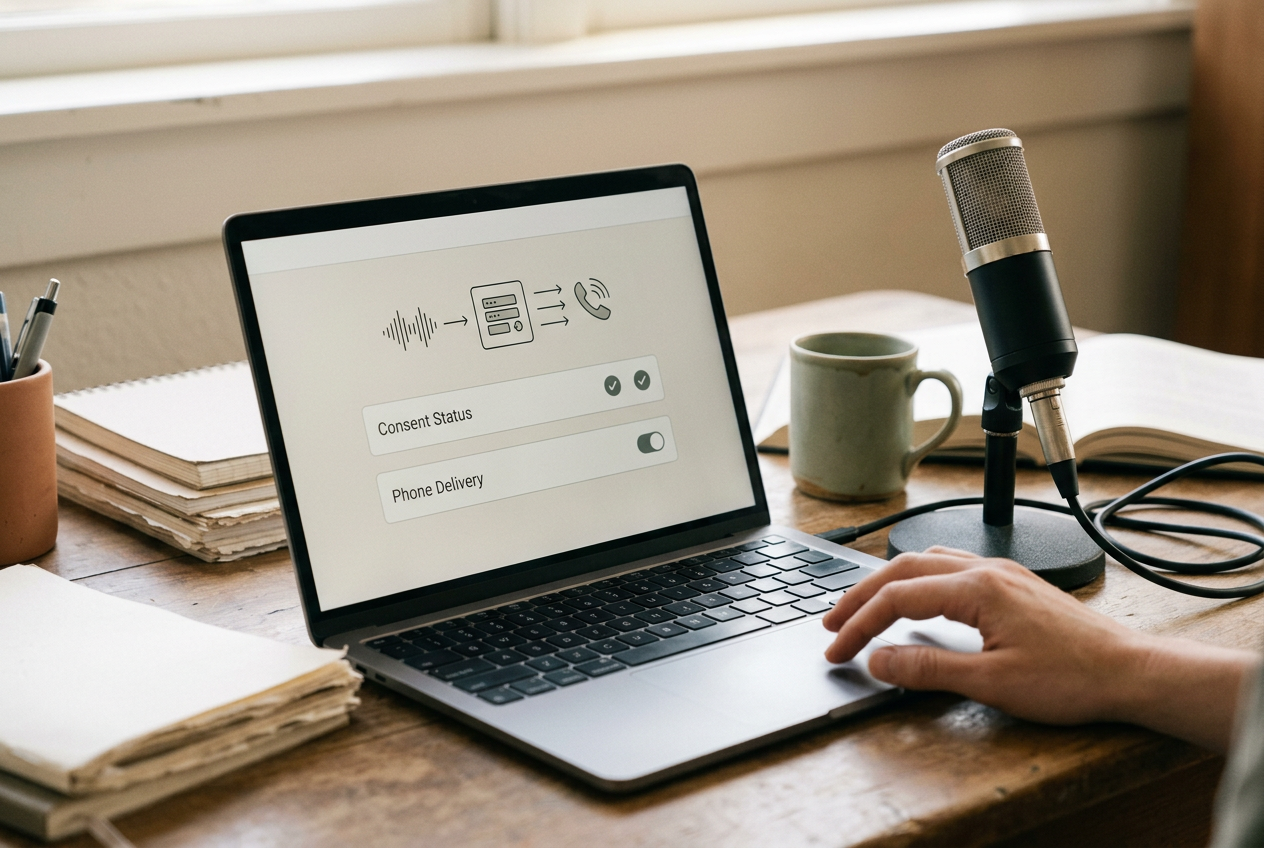
Consider one ordinary product screen: a user uploads a voice sample, types a script, selects “phone call” as the delivery channel, and schedules a batch of messages. The service turns the sample into a voice model, which is a mathematical representation used to synthesize new speech, then sends the recording through a calling provider.
That screen crosses several legal boundaries before the first call connects. Creating the model may implicate biometric privacy rules. Generating speech in an identifiable person’s voice may touch publicity or digital-replica rights. The script and context can raise deceptive impersonation rules.
Delivering it by phone brings federal and state calling restrictions into the workflow.
The difficult product question is no longer whether the user accepted general terms. It is whether the service can show whose voice was used, what that person authorized, which use was disclosed, whether consent remains active, and where the resulting audio may be delivered.
This is an engineering map, not legal advice. The applicable answer depends on facts that a generic compliance toggle cannot resolve, including where the speaker and recipient are located, whether a voiceprint was created, and whether the call markets a product.
One upload can create two different regulated objects
A recording and a voiceprint are not necessarily the same thing. Illinois’ Biometric Information Privacy Act, commonly called BIPA, includes a “voiceprint” in its definition of biometric identifier. A service that merely stores audio may present a different issue from one that extracts a template to recognize or reproduce the speaker, although product labels such as “voice cloning” do not settle that analysis.
Where BIPA applies, a private entity collecting or obtaining covered biometric data must inform the subject in writing that it is being collected or stored, state “the specific purpose and length of term” for the collection, storage, and use, and receive a written release. The law also addresses retention schedules and destruction. Illinois is especially consequential because BIPA permits private lawsuits, while biometric statutes in some other states rely primarily on government enforcement.
Texas law also identifies a voiceprint as a biometric identifier and restricts capturing one for a commercial purpose without notice and consent. The wording, enforcement route, exemptions, and covered conduct are not interchangeable with Illinois. A nationwide service therefore cannot treat “biometric consent obtained” as a context-free Boolean value.
Return to the upload screen. Before accepting the sample, the service needs to know whether the uploader is the speaker or has authority to act for that person. It also needs to record the disclosed purpose: producing one approved script, operating a reusable model for a company account, or licensing the model to other customers are materially different permissions.
The record should preserve the notice version, consent text, timestamp, account, claimed relationship to the speaker, authorized purposes, retention period, and the particular model or dataset covered. Keeping only a checked box proves little if the notice changes later or the model is copied into another workspace.
Identity verification adds cost and friction. A low-risk personal narration tool might ask the speaker to record a challenge phrase and confirm through a verified channel. A marketplace selling celebrity-style voices needs stronger evidence and manual review. Neither method proves every underlying right, but both create more useful evidence than an uploader typing a name into a form.
Permission to build a model is not permission for every output
Publicity rights protect aspects of a person’s identity against certain unauthorized commercial uses, and their scope varies substantially by state. Tennessee’s ELVIS Act expressly protects voice against unauthorized AI uses. Its definition reaches “a sound in a medium that is readily identifiable and attributable to a particular individual,” whether it contains the person’s actual voice or a simulation.
California has separately addressed digital replicas in entertainment contracts and protections involving deceased personalities. One contract rule makes certain digital-replica provisions unenforceable when they lack a “reasonably specific description” of intended uses and the performer was not professionally represented in negotiating the provision. That requirement points toward use-specific product records rather than perpetual, all-purpose consent.
A service should therefore separate model creation from output authorization. The speaker may permit an audiobook narration but reject advertising, political messages, adult content, or real-time phone conversations. That distinction belongs in the policy engine that approves generation, not in a PDF stored where the rendering system cannot read it.
On the campaign screen, the script, delivery method, named sponsor, audience, and commercial category should be checked against the consent scope. A mismatch can route the job to review or block it. This creates false positives and delays unusual projects, but post-publication removal is a weak fallback once a cloned recording has been downloaded or sent to thousands of recipients.
Contract language still matters. It just cannot carry the whole load. A customer warranty that they hold necessary rights helps allocate responsibility between parties; it does not verify consent, prevent a prohibited generation, or produce the records an auditor will request.
Phone delivery changes the control plane
In 2024, the Federal Communications Commission confirmed that AI-generated voices fall within the Telephone Consumer Protection Act’s restriction on calls using an “artificial or prerecorded voice.” Covered calls require prior express consent unless an exemption applies, and telemarketing calls face a stricter written-consent framework under FCC rules.
That consent concerns the person receiving the call. It is distinct from permission granted by the person whose voice was cloned. A compliant workflow may need both: authority to synthesize the speaker and permission to contact the recipient using an artificial voice.
The calling layer also carries disclosure and opt-out obligations depending on the call. State telemarketing and automated-call laws can add restrictions beyond the federal baseline. Political calls occupy another category, with state rules increasingly addressing synthetic media and election communications, sometimes through disclaimers and sometimes through timing or intent-based provisions.
The campaign screen should consequently refuse to convert a voice-model consent record into calling consent. It should attach recipient-level evidence to each number, classify the call’s purpose, insert required identification or disclosure language, and pass revocation events back from the calling provider. If a recipient opts out during a call, the suppression should apply before the next scheduled batch rather than waiting for a periodic account review.
Disclosure also needs to survive the delivery path. Text shown beside an audio player does nothing for a recipient who only hears a phone call. For downloadable audio, metadata can carry provenance information, but metadata is easily stripped; an audible statement may be needed where a law, platform rule, or risk policy calls for one.
Geography is a decision input, not an account setting
A single “US customer” field cannot select the correct rules. The relevant places may include the speaker’s residence, the customer’s location, the recipient’s location, where a recording session occurred, and where the output is published. A mobile number does not reliably establish current location, while IP geolocation can be wrong or obscured.
A practical policy service can evaluate the known facts at several gates. At enrollment, it applies rules tied to the speaker and collection of the sample. At generation, it checks the authorized use and content category. Before delivery, it evaluates the recipient list, channel, campaign type, and available consent evidence.
Uncertainty should produce a defined fallback, such as excluding a jurisdiction, requiring manual review, or allowing generation while disabling automated phone delivery.
Geographic restrictions are easy to promise and imperfect to enforce. Blocking an Illinois billing address will not catch every Illinois resident, and a customer can download audio before redistributing it elsewhere. The service should distinguish controls it enforces from customer promises it merely records, then expose that distinction in the audit log.
That log should show the policy version, inputs, decision, disclosure inserted, reviewer override, and resulting artifact identifier. It should not store sensitive voice data forever just to prove that a check occurred. A hash, meaning a one-way digital fingerprint of a file, can link an output to a decision record without duplicating the recording, although the surrounding evidence still needs a retention schedule.
Revocation has to reach the model and its copies
A “delete voice” button is only credible if the service knows where the model went. Revocation should stop new generation, disable pending campaigns, remove the voice from discovery, and trigger deletion or restriction across production storage, caches, fine-tuning datasets, and vendor systems according to the governing policy and agreement.
Previously exported audio presents the hard limit. A provider can remove hosted files and disable links, but it may be unable to retrieve copies already downloaded by customers or delivered to recipients. The consent screen should not imply otherwise. The product can instead record export events, watermark or label outputs where appropriate, and notify affected customers when authorization ends.
Some controls can ship without resolving every state-law interpretation: immutable consent versions, purpose-bound permissions, separate speaker and recipient consent, machine-readable revocation, and policy decisions logged at generation and delivery. Those controls do not guarantee compliance. They make the service’s factual claims testable, which is the starting point for counsel, auditors, platforms, and customers evaluating the same campaign screen.
Questions people ask
Is recording someone’s voice enough to create a voiceprint?
Not necessarily. A voiceprint generally refers to biometric characteristics extracted for recognition or another identifying function, while an ordinary audio file may only contain recorded speech. The distinction depends on what the system computes and how it uses the result, so product documentation should describe the pipeline rather than relying on the label attached to the feature.
Does a user accepting the terms give permission to clone any voice?
No. General terms can require users to hold appropriate rights, but they do not establish that a particular speaker received a specific notice or authorized a particular use. A service needs evidence connected to the speaker, model, purpose, retention period, and account that generated the output.
Does an
AI voice disclosure make a robocall permissible?
No. A disclosure tells the recipient that audio is synthetic; it does not replace consent required for covered artificial or prerecorded voice calls. The service must evaluate calling permission, call purpose, identification and opt-out requirements, and any applicable state restrictions separately from permission to clone the speaker.
Can a service fully revoke a cloned voice after customers download it?
Usually not. It can block new generation, cancel queued delivery, remove hosted copies, and instruct vendors or customers to delete covered material. It cannot reliably retrieve every exported file, which is why export logs, bounded licenses, disclosure controls, and clear statements about deletion limits matter before the first download.
One story a day
The story of the day, in your inbox
One real story about AI each morning — no hype, no alarm, just company for the road.