Your Customer-Service Bot May Need to Identify Itself Up Front
US disclosure duties turn on location, purpose, profession, and channel. A visible label at first contact is the cleanest baseline, but voice callbacks and human handoffs need separate controls.
August 9, 2026 · 8 min read
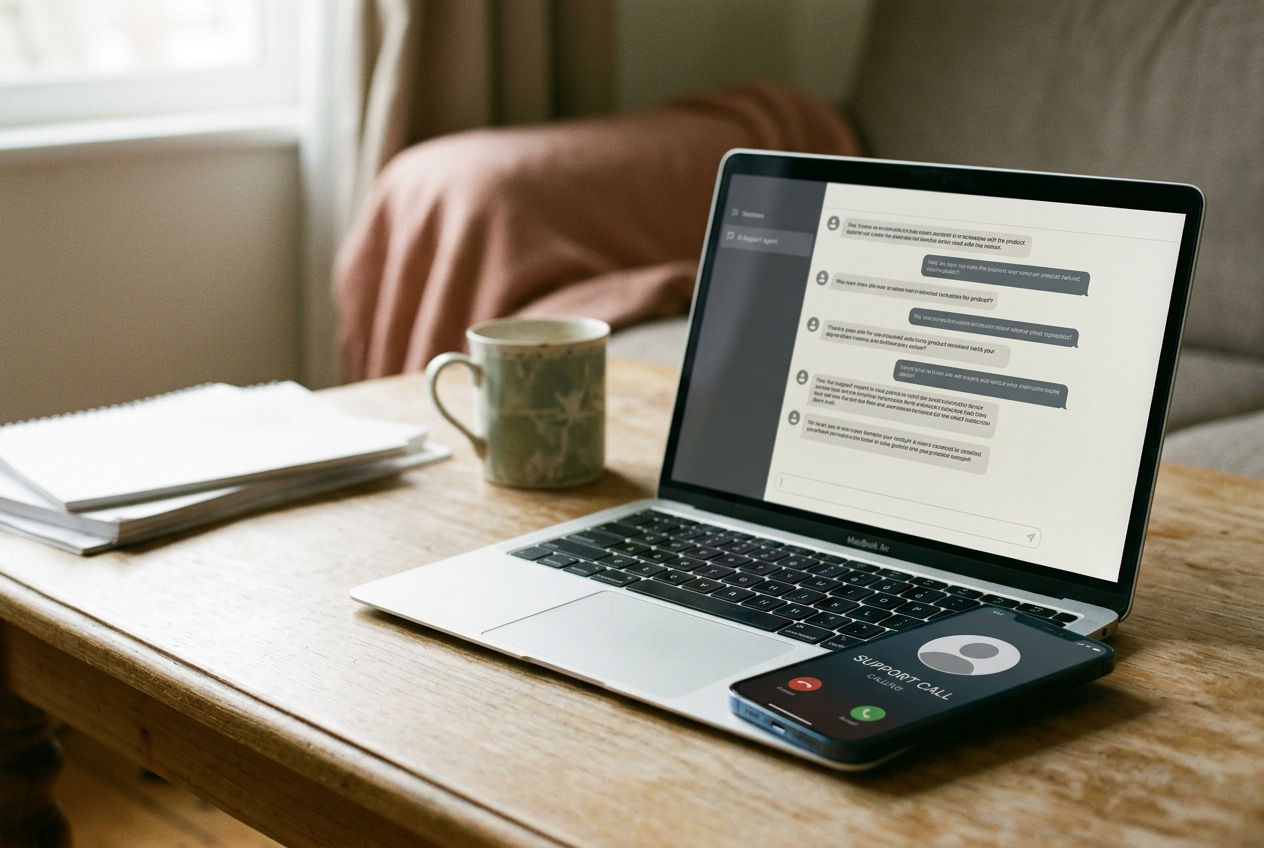
Consider one ordinary support flow. A customer opens a retailer’s chat widget, asks for a refund, accepts an automated callback, and then reaches a human after the voice bot cannot verify the order. The system has crossed three interfaces, but a disclosure shown above the first chat message may not follow it.
That gap matters because the United States does not have one general law requiring every customer-service bot to announce itself. California and Utah attach disclosure to different conditions. Colorado has enacted a broader consumer-interaction rule with a delayed implementation timeline. Federal agencies can still act against deception or regulate particular communications, while an explicit federal rule for AI-generated calls remains a proposal rather than a blanket requirement.
For the retailer, the practical decision is not whether to add one sentence to a widget. It is where to disclose, what the words must convey, which system records delivery, and what happens when the channel changes.
California targets deceptive commercial bot use
California’s operative bot law is narrower than the claim that every business chatbot must carry a label. It applies to certain online bot communications made with an intent to mislead another person about the bot’s artificial identity, where the purpose is knowingly to deceive that person about the content of the communication in order to encourage a purchase or sale of goods or services. Political communications are covered through a separate purpose trigger.
When the statute applies, the disclosure must be “clear, conspicuous, and reasonably designed to inform persons with whom the bot communicates or interacts that it is a bot.” That quoted requirement is useful for interface design. A disclosure buried in terms of service is difficult to reconcile with a command that it be conspicuous and designed to inform the person in the interaction.
The trigger still requires legal analysis. California defines a bot around an automated online account, and a company should not assume without review that every embedded support widget fits the definition in the same way as a social-media account. Intent and purpose matter too. A refund bot that plainly labels itself presents a different case from a sales assistant built to impersonate a store employee and steer customers toward a product.
Return to the retailer’s workflow. If the chat opens with “Virtual assistant” in a small header but the bot writes “I checked with our warehouse,” counsel may ask whether the total presentation contradicts the label. Disclosure is not just a noun in the corner. First-person claims, profile photos, typing indicators, invented signatures, and claims of personal experience can change what a reasonable customer understands.
Utah uses profession and customer-prompt triggers
Utah’s AI Policy Act takes another route. For activity covered by the state’s consumer-protection framework, a person causing generative AI to interact with someone must disclose that the person is interacting with generative AI rather than a human if the person asks or prompts for that information. Generative AI means a system that produces synthetic content from prompts or other inputs.
The law places a stronger affirmative duty on providers of services in regulated occupations: they must prominently disclose when a person is interacting with generative AI in the provision of those regulated services. A support bot handling a routine retail return and a bot communicating as part of a licensed professional service therefore may face different disclosure triggers, even if both use the same model and contact-center software.
The implementation problem is recognizing a request. Customers rarely type the statutory concept. They write “Are you real?”, “human?
”, “is this automated?” or “am I talking to a person?” A keyword filter will miss paraphrases, misspellings, speech-recognition errors, and questions asked after several turns. The safer engineering pattern is to treat identity questions as a dedicated intent, test it against varied language, and route low-confidence cases to an answer that identifies the system rather than improvising.
That answer also needs protection from the model. If a large language model, software that generates text by predicting likely sequences, controls the response freely, it can hedge or claim human status despite the interface label. Teams can instead serve approved disclosure text outside the model, just as they would serve a privacy notice or required payment warning.
Colorado points toward disclosure by default
Colorado has enacted a broader provision for AI systems intended to interact with consumers. Its text says the developer or deployer must ensure disclosure “to each consumer who interacts with the artificial intelligence system that the consumer is interacting with an artificial intelligence system.” The law includes an exception where that fact would be obvious to a reasonable person.
This is enacted legislation, not merely an agency suggestion, but its requirements have had a delayed effective date and the implementation timetable has been subject to legislative attention. A business planning a launch should verify the current date and any amendments rather than copy an old compliance calendar from a vendor presentation.
The “obvious” exception is also a risky product shortcut. A sparkling icon or the assistant’s unnatural speed may look obvious to its designers while meaning nothing to a customer. A two-word label usually costs less than documenting why an unlabeled interface should have been self-evident.
In the retailer’s chat, “AI assistant” beside the first message would make the status explicit. The record should show which notice version rendered, in which language, at what time, and in which channel. Logging only that the workflow was configured to display a notice cannot prove that a broken component, blocked script, or mobile layout did not hide it.
Voice changes the legal and design problem
The callback is not merely chat read aloud. An outbound automated call can implicate the Telephone Consumer Protection Act and Federal Communications Commission rules governing artificial or prerecorded voices, including consent and caller-identification requirements. In 2024, the FCC confirmed that AI-generated human voices fall within the law’s treatment of an “artificial or prerecorded voice.”
The FCC has separately proposed requiring callers to disclose at the beginning of a call that it uses an AI-generated voice. That specific AI announcement should be treated as proposed unless and until a final rule makes it operative. Existing calling rules still apply independently, and whether a requested support callback has valid consent depends on facts beyond the presence of an AI label.
A voice disclosure belongs in the opening audio, before the bot asks for an order number or starts a sales conversation. It adds time to every call and can increase early hang-ups, but hiding it after authentication defeats its purpose. Google made identification part of the opening behavior for its Duplex automated calling system, illustrating a platform practice that goes beyond waiting for the recipient to detect synthetic speech.
Recording notices are separate. “This is an automated assistant” tells the customer who or what is speaking; it does not necessarily satisfy state rules governing call recording. Combining both ideas into one rushed sentence may also reduce comprehension, especially when text-to-speech audio meets background noise or a poor connection.
Human handoff needs a visible state change
After the retailer’s voice bot fails verification, it transfers the call. The customer should hear that a human agent is joining, while the agent’s console should identify what the bot collected and which promises it made. A transcript alone is insufficient if it omits tool actions such as a refund request that failed after the model told the customer it had succeeded.
The reverse transition matters too. If a human leaves the conversation and automation resumes, the interface should announce that change rather than preserve the human agent’s name and avatar. For chat, a persistent status label can update from “AI assistant” to “Support agent.” For voice, a short spoken transition is clearer than relying on a subtle change in cadence.
Agent assist, where AI drafts answers for a human who reviews and sends them, raises a different issue from direct bot interaction. The customer may be communicating with a person even though AI operates behind the screen. State definitions and professional rules determine whether that internal use creates a disclosure duty, so teams should document who selects the final message, whether drafts can send automatically, and whether the system performs actions without review.
Build the receipt before choosing the wording
A disclosure control needs an owner, a trigger, and evidence. Product teams should take counsel a channel map showing where the bot first contacts the customer, whether it sells or only supports, which states and regulated services are involved, how identity questions are detected, and where automation gives way to a person. This is an implementation checklist for legal review, not legal advice.
The receipt is as important as the sentence. Store the approved text, presentation rules, deployment period, language, delivery event, and handoff state under the same change controls used for other customer notices. Screenshots help during design review, but event logs show what the production system attempted to display or play.
Finally, test the whole retailer journey rather than the opening screen. Start on a narrow phone display, ask whether the assistant is human, request the callback, interrupt its opening, fail verification, and wait for the transfer. The failure to catch is concrete: the customer hears a synthetic voice using a human agent’s identity because the chat session carried the wrong presentation state into the call.
Questions people ask
Does every
AI chatbot in the United States have to identify itself?
No. There is no single nationwide rule that imposes the same affirmative disclosure on every chatbot. Duties can depend on deceptive intent, commercial purpose, the customer’s location, a regulated occupation, or the communication channel, while federal consumer-protection law can still reach a presentation that materially misleads customers.
Is an
“AI assistant” label in the chat header enough?
It may be a useful first disclosure, but placement and the rest of the interface matter. Test whether the label remains visible on mobile devices and in reopened sessions, and make sure names, avatars, generated claims, or typing behavior do not create a conflicting impression that the customer is speaking with a human.
Must a voice bot disclose that its voice is AI-generated?
AI-generated outbound voices fall under existing federal rules for artificial or prerecorded voice calls. The FCC has proposed a specific opening disclosure for AI-generated calls, but a proposal is not the same as an operative final rule. Consent, caller identification, recording, and state-law questions require separate review.
What should happen when the bot transfers me to a human?
The system should announce the change and update the visible or spoken identity of the participant. It should also give the human a record of disclosures, customer inputs, tool actions, and unresolved failures, so the agent does not repeat a false promise or assume that a refund the bot discussed was completed.
One story a day
The story of the day, in your inbox
One real story about AI each morning — no hype, no alarm, just company for the road.