A Recording Release Is Not Consent to Clone a Voice
A synthetic voice can outlast the recording session, the vendor contract, and the speaker’s employment. Permission needs separate decisions for creation, reuse, transfer, and exit.
August 9, 2026 · 8 min read
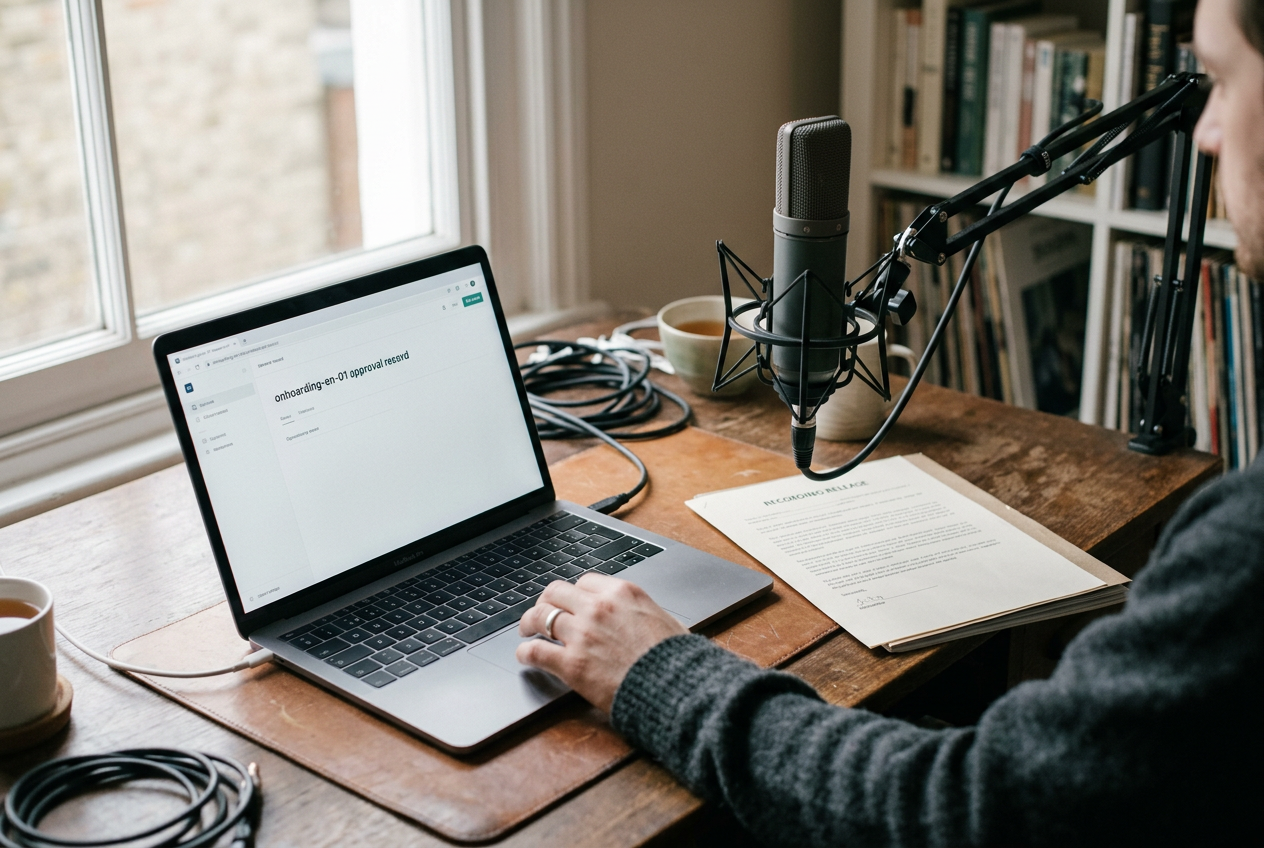
Consider a company commissioning an employee to voice its English-language onboarding course. The employee reads approved scripts into a studio microphone, the production team uploads the WAV files to a voice platform, and the platform creates a synthetic voice labeled `onboarding-en-01`. Months later, a manager types a new safety announcement and downloads speech that the employee never recorded.
The original recording release may cover the studio session and the finished course. It may say nothing about building a reusable voice model, generating unseen scripts, sharing access with an outside agency, or continuing after the employee leaves. Those are separate actions, both technically and operationally. Treating one signature as permission for all of them leaves the organization without a reliable answer when the first unplanned use arrives.
That gap matters because voice cloning no longer always means conventional model training. Some systems fine-tune model weights on a speaker’s recordings. Others compute a voice embedding, a numerical representation of vocal characteristics, from a short sample and use it to condition speech generation. A contract that mentions only “training” may miss a system that creates a persistent embedding without retraining its base model.
Follow the voice through the system
The useful review starts with the actual workflow, not a broad clause permitting “AI use.” For `onboarding-en-01`, the organization first records and stores source audio. A vendor or internal team cleans the files, aligns them with transcripts, and derives the artifact used to reproduce the speaker. Someone then submits text, the system generates audio, and another person publishes or distributes the output.
Permission should follow those steps. Recording consent covers capture, editing, storage, and the originally commissioned production. Model-creation consent covers using those files to build a fine-tuned model, embedding, voice profile, or functionally similar artifact. Generation consent controls which new words may be produced.
Distribution permission determines where that speech may appear and who may receive it.
These distinctions are not paperwork for its own sake. A person may accept a synthetic voice for correcting pronunciation in one course while rejecting unrestricted generation for advertisements, political messages, disciplinary notices, or translations into languages they do not speak. The organization also needs to decide whether approval attaches to each script, to a defined category of scripts, or to any request submitted by authorized staff.
Per-script approval gives the speaker the most control, but it adds review time and can block urgent updates. Category approval is faster if the boundary is testable, such as “internal onboarding modules approved by the learning team.” A grant covering all company communications costs less to administer, although it creates the largest mismatch between what the speaker expected at the microphone and what the system can later make the voice say.
Write down reuse rather than implying it
The permission record for `onboarding-en-01` should identify the approved purpose, channels, audience, languages, territories, term, and script-approval method. It should also name the model or service where possible and state whether the vendor may use the recordings or derived voice profile to improve a general-purpose model.
That last point changes the risk. Using the audio only to operate the commissioned voice keeps the asset tied to the organization’s account. Allowing general model improvement can mix information derived from the speaker into a broader training pipeline, where isolating and removing its influence may be difficult. A promise to delete uploaded WAV files does not necessarily delete a fine-tuned checkpoint, an embedding, cached outputs, backups, or training data already incorporated into another model.
Sublicensing needs equal precision. A production agency may require access to generate approved modules, while a cloud provider may handle inference, the computation that turns submitted text into audio. Neither role automatically justifies letting the recipient sell the voice, expose it through an API, or use it for unrelated customers.
The contract and technical controls should agree. If permission allows only the learning team to generate internal training, a shared account with unrestricted download access defeats that boundary. Role-based access, which grants capabilities according to a user’s job, can limit who submits text and who releases completed audio. An approval screen should display the script, intended destination, consent record, and voice identifier before generation or publication.
Consent rules are not interchangeable
Different rules address different points in this chain. They should not be collapsed into a claim that voice cloning is either broadly permitted or broadly prohibited.
California’s AB 2602 says certain contract provisions concerning a performer’s digital replica are unenforceable when the agreement lacks a “reasonably specific description of the intended uses of the digital replica” and the performer was not professionally represented in the negotiation. Its scope and exceptions matter, but the engineering lesson is direct: “all media, forever” does not create a usable specification for a generation system.
SAG-AFTRA’s published summaries of negotiated film, television, and interactive-media terms similarly distinguish consent to create a digital replica from consent to use it. Those are contract protections for covered work, not a universal statute applying to every employee, contractor, or customer recording.
The Federal Communications Commission has ruled that AI-generated voices count as an “artificial or prerecorded voice” under the Telephone Consumer Protection Act. Covered calls generally require the called party’s prior express consent unless an exception applies. That consent belongs to the recipient of the call; it does not replace permission from the person whose voice was cloned.
The European Union’s AI Act adds another layer. Article 50 requires deployers of covered deepfake audio to “disclose that the content has been artificially generated or manipulated,” subject to the regulation’s scope and exceptions, with those transparency duties scheduled to apply in August 2026. Disclosure tells an audience that audio is synthetic. It does not by itself authorize the model’s creation or the speaker’s reuse.
State publicity, biometric, employment, contract, and consumer-protection rules may also apply, depending on the person, location, data, and use. Organizations need qualified counsel for that analysis. The governance task comes earlier: give counsel and decision-makers an accurate map of what the system will do.
Revocation has to map to something the system can execute
A clause saying consent is “revocable” is incomplete unless it says what happens next. Revocation could stop future generation while allowing already published modules to remain online. It could require removal from active channels after a defined period, deletion of the voice profile, or notice to agencies and vendors that received access. Each option has a different operational cost.
For `onboarding-en-01`, the exit procedure should specify who disables generation credentials, who inventories published audio, and which records must remain for audit or dispute handling. The organization should distinguish active production storage from backups, because immediate removal from every backup may be technically unavailable even when the voice disappears from normal use.
Post-employment use needs its own decision. Employment ending does not answer whether existing modules can remain available, whether new speech can be generated, or whether the company may update old scripts in the former employee’s voice. Continuing to generate fresh lines after departure is materially different from retaining a course completed during employment, and the permission record should say which action is allowed.
If the organization promises deletion, procurement should confirm that the vendor can delete source audio, embeddings, fine-tuned models, test outputs, and accessible copies held by subprocessors. Where a vendor cannot isolate a speaker’s contribution to a shared model, the organization should not promise that it can erase that contribution later. The fallback is a dedicated model with documented deletion controls, conventional recording sessions, or a licensed stock voice whose reuse terms already match the project.
Keep receipts for every generated line
A consent record becomes useful only when generation systems check it. Before accepting text for `onboarding-en-01`, the service should verify that the permission remains active and that the requester, purpose, and destination fall within scope. High-risk or out-of-scope scripts should stop at human review rather than relying on a warning buried in account settings.
The audit log should connect the consent version to the voice identifier, submitted text, requester, generation time, output file, intended channel, and approval result. Recording every script may capture confidential material, so access and retention need limits; logging nothing, however, makes it hard to prove whether an objectionable clip came from the approved system or from an unauthorized clone elsewhere.
This setup costs more than a release filed beside the original WAV files. Legal review, restricted vendor accounts, output logging, and offboarding all add work, while per-script approval adds delay. The cheaper alternative is appropriate when synthetic reuse offers little value: record replacement lines with the speaker, commission a new performer, or use a stock synthetic voice with terms designed for ongoing generation.
The purchase order should not move until the organization can answer the five missing decisions in writing: how the voice artifact is created, what speech it may generate, who may receive or operate it, what revocation changes, and what survives the end of employment or engagement. Those answers belong beside the identifier `onboarding-en-01`, where the generation service and its operators can use them.
Questions people ask
Does consent to record someone permit voice cloning?
Not necessarily. Recording permission may cover capture, editing, and publication of specified audio without authorizing a model, embedding, or voice profile that can generate new speech. The agreement should describe model creation and later generation separately, with the intended uses stated precisely enough to enforce through access and approval controls.
Can an employer keep using a cloned voice after the employee leaves?
Only if the governing agreement and applicable rules support that use. The document should distinguish retaining previously approved recordings from generating new lines after employment ends, then specify the term, channels, approval rights, and deletion duties. Employment status alone does not resolve those questions.
Can a person revoke voice cloning consent?
That depends on the agreement and applicable law, but any promised revocation needs an executable result. It should state whether revocation stops new generation, removes published outputs, deletes the voice artifact, or triggers notices to vendors. Backups and shared-model training may limit what can be removed immediately.
Does labeling audio as AI-generated solve the consent issue?
No. Disclosure tells listeners that audio was generated or manipulated, and some uses may require it. It does not establish permission to record the speaker, create the voice artifact, generate a particular script, or transfer the voice to another operator. Consent, disclosure, and distribution controls answer different questions.
One story a day
The story of the day, in your inbox
One real story about AI each morning — no hype, no alarm, just company for the road.