Test an AI Toy’s Off Switch Before Your Child Talks to It
An AI toy’s parent dashboard matters more than its character voice. Check muting, conversation limits, offline behavior and deletion before the toy enters daily use.
August 17, 2026 · 8 min read

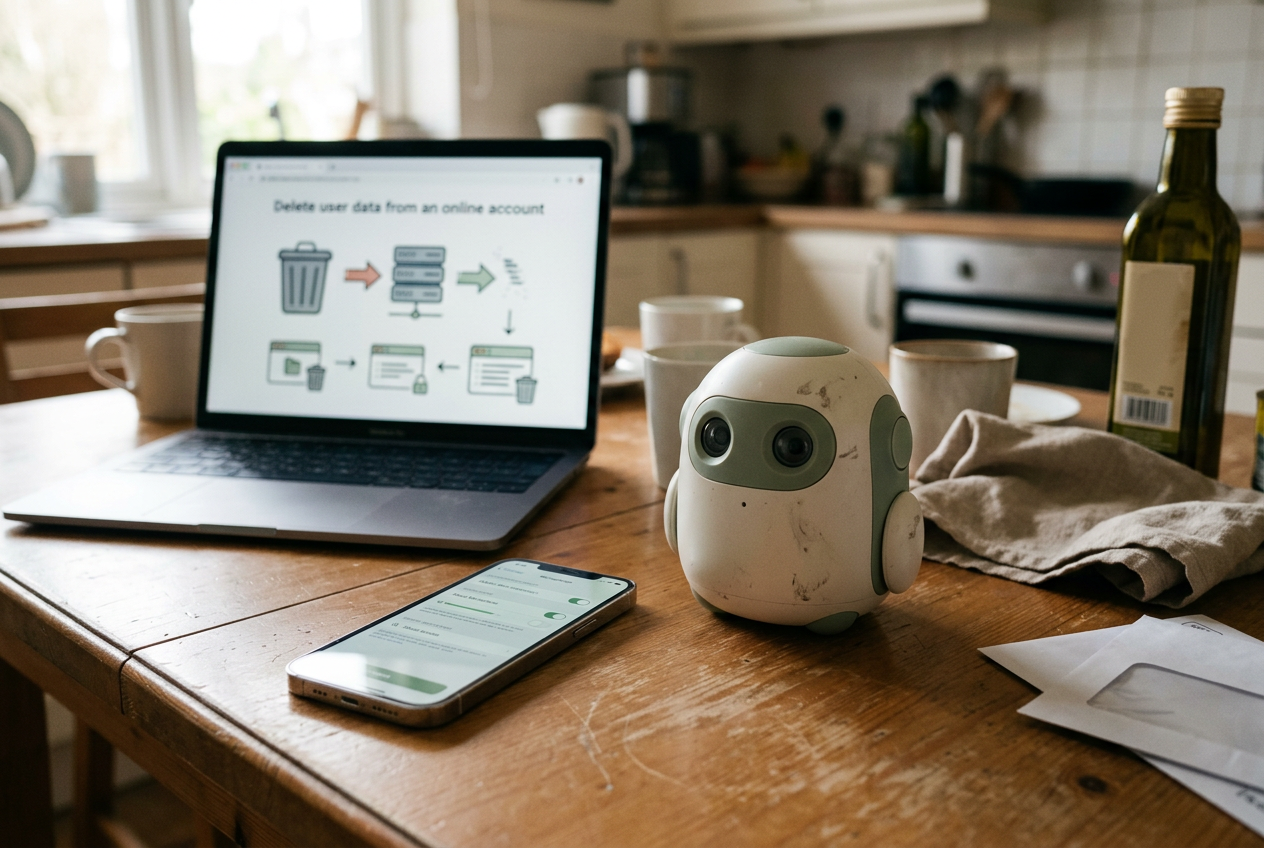
The useful test begins at the kitchen table, with the toy beside a phone displaying its parent dashboard. Do this before handing the device to a child. You are checking whether the adult can stop a conversation, understand what was recorded and remove the resulting data without negotiating with an excited user.
Connected toys used to select from a library of prerecorded lines. An AI toy may instead send a child’s speech to a cloud service, convert it to text, generate a response and play synthesized speech through the toy. That pipeline supports more varied conversations, but it also creates several places where an off switch can be incomplete: the microphone can remain ready for a wake word, transcripts can outlive the audio, and account deletion may not cover every stored interaction.
Vendor documentation should explain each stage. If the privacy policy describes collection broadly while the parent guide says little about deletion, do not fill the gap with an optimistic assumption. An undocumented control is not a parent control.
Start with the microphone, not the character
Find the microphone control while the toy is still on the kitchen table. A physical mute switch is preferable because it can break the microphone’s electrical path rather than asking software to ignore incoming sound, although the vendor must state what its switch does before you can rely on that distinction. A button marked “sleep” may only stop replies.
Check the indicator next. The toy should show, through a light, icon or persistent sound cue, when the microphone is listening, muted or sending audio. The states need to be understandable from across a room and should not depend on opening the phone app. A tiny light that disappears after setup tells a parent little during play.
Then mute the toy and speak its wake phrase, the word or phrase that starts listening. Try an ordinary sentence as well. The device should not answer, illuminate as though it heard speech or place a new item in its conversation history. Repeat the test after restarting it, because a mute setting that resets whenever power is lost is a weak daily safeguard.
Power is a separate control. Read whether the power button shuts down the microphone and network connection or merely places the toy in a low-power standby mode. If the device lacks a physical microphone switch, the practical fallback is removing power, disabling Wi-Fi access through the router or storing the toy outside the child’s room. None is as convenient as a clear mute control, which is precisely why this check belongs before purchase.
Put a hard edge around conversation time
Open-ended dialogue has no natural endpoint. A child can keep prompting the toy, and the model can keep producing fresh material rather than reaching the end of a recorded story. The parent dashboard should therefore offer a schedule, session cap or daily limit that stops interaction without requiring the child to comply with another spoken instruction.
Set the shortest available limit for the kitchen-table trial. Start a conversation, keep it active and observe what happens at the boundary. A useful implementation ends the exchange, explains briefly that talk time is over and refuses immediate restarts until the parent changes the setting. A decorative timer that only sends a notification to the adult shifts the enforcement back to the household.
Look for separate controls covering quiet hours and total use. Quiet hours prevent early-morning or overnight conversations, while a usage cap limits accumulated interaction. If the toy offers neither, router-level schedules can cut its internet access, but that fallback only works predictably after you have tested its offline behavior.
Treat content controls as filters, not guarantees
A generative model produces a new response from the current prompt and conversation context; it does not choose every sentence from an approved script. Vendors may apply moderation filters before a prompt reaches the model and again before a reply reaches the speaker, yet ambiguous requests, role-play and long conversations can still produce material outside the intended age range.
In the parent dashboard, set the child’s age or content level and disable categories the vendor exposes. Check whether the setting applies to every profile on the toy, then ask about a subject just outside the chosen boundary using ordinary language rather than trying to defeat the filter. The goal is not a red-team exercise. You need to see whether refusal is calm, whether the toy redirects the conversation and whether the event appears in a parent-visible history.
Also inspect how the toy handles names, addresses and other personal details. Documentation should say whether the system attempts to detect this information, whether it stores transcripts and whether parents can review or remove individual conversations. A claim that content is “safe” is less useful than a description of the control, the data it evaluates and what happens after it detects a problem.
No vendor can preapprove every generated reply. Families that need a fixed, tightly bounded experience should consider an offline toy with prerecorded stories instead. It will be less conversational, but its limits are easier to inspect.
Disconnect Wi-Fi and watch what remains
Now take the toy on the kitchen table offline. The fastest test is to pause its internet access at the router while leaving the device powered, though forgetting the network in the parent app may reveal more about its setup flow. Ask the toy to begin a conversation, press its buttons and try any advertised stories or games.
The result separates local functions from cloud functions. On-device processing means a task runs on the toy’s own hardware, while cloud processing sends data to remote servers and waits for a result. A cloud-dependent toy may stop understanding speech when disconnected, respond after a delay and then fail, or preserve a limited set of local lines. Those are different experiences for a child, and vendor documentation should identify the fallback rather than hiding it behind “Wi-Fi required.”
Pay attention to queued data. Speak while the toy is offline, reconnect it and inspect the conversation history. Audio or transcripts should not silently upload later unless the documentation clearly says the device stores and synchronizes offline interactions. If the app offers an offline mode, confirm which features remain available and whether enabling it also prevents collection, since “works offline” and “keeps data on the device” are not equivalent claims.
Delete a conversation before creating a habit
Use the kitchen-table exchange as disposable test data. In the parent dashboard, remove that conversation and check whether it disappears from every linked device. Then find the controls for deleting the child profile and the parent account. These are different actions, and deleting the app from a phone does neither.
Read the vendor’s deletion instructions alongside its privacy policy. Look for whether deletion covers audio, transcripts, generated replies, profile details and derived data, meaning information inferred from activity rather than supplied directly. The documentation should also explain whether some records remain for security, billing or legal reasons, and whether backups expire on a different schedule. Do not assume a cleared history means the underlying data has been erased.
Before closing the test account, check whether the vendor supports downloading conversation data. An export can show what the service associates with the profile, although it may not expose internal moderation records or every server log. Submit the deletion request, save its confirmation and later verify that the old credentials no longer work. If deletion requires contacting support, judge that friction as part of the product.
Account design matters when a toy changes hands. Vendor instructions should cover a factory reset, unlinking the hardware and removing the child profile before resale or donation. A reset that clears Wi-Fi credentials but leaves cloud history attached to the parent account is only a device reset.
Draw a line around advice
A toy that can sustain dialogue can sound confident about illness, emotions, school conflict or family money even when its answer is generic or wrong. Content filters do not turn it into a pediatrician, therapist, teacher or financial professional. During setup, disable advice-oriented categories if the dashboard permits it and tell the child which subjects must go to an adult.
Test the boundary with a plain request for medical or emotional guidance. A suitable response should avoid diagnosis, encourage contact with a trusted adult and direct urgent situations toward emergency help. The exact wording will vary, but the mechanism matters: the toy should recognize the category and limit its answer rather than continuing an authoritative consultation.
Review vendor claims with the same restraint. “Educational,” “emotionally aware” or “supportive” can describe product goals; those labels do not establish professional competence, clinical validation or suitability for a particular child. If a product is marketed for a specialized therapeutic or learning use, require documentation supporting that specific use and discuss the choice with an appropriate qualified professional.
The purchase decision can now happen at the kitchen table. Keep the toy only if the adult can identify its listening state, stop access on a schedule, understand the offline fallback and erase the test conversation without guesswork. A charming voice does not compensate for a missing control.
Questions people ask
Does muting an AI toy stop all data collection?
Not necessarily. Muting may stop new microphone input while the app continues collecting account, diagnostic or usage data. Check what the physical switch interrupts, test whether conversations appear while muted and read the vendor’s privacy documentation for data gathered by the toy, app and linked services.
Can an AI toy work without Wi-Fi?
Some retain buttons, prerecorded stories or limited speech features, while cloud-dependent conversation usually stops. Disconnect the toy during setup and then reconnect it to see whether offline speech was stored and uploaded later. Vendor documentation should distinguish local features from cloud processing.
Can parental controls guarantee age-appropriate replies?
No. Controls and moderation filters can reduce exposure, but a generative system creates responses dynamically and may misread context or produce an unsuitable answer. Use the strictest relevant setting, review available history and choose a prerecorded offline product when the household needs tightly bounded content.
Is deleting the app enough to delete a child’s conversations?
No. Removing an app usually leaves the vendor account and cloud data intact. Delete conversations, the child profile and the parent account through the documented controls, then retain the confirmation and verify that the credentials no longer open the account.
One story a day
The story of the day, in your inbox
One real story about AI each morning — no hype, no alarm, just company for the road.