Translation Earbuds Still Lose the Table When Everyone Talks
Translation earbuds can sustain a careful one-to-one exchange. A restaurant adds overlapping voices, unfamiliar dish names, music, and enough delay to make the phone a necessary fallback.
August 9, 2026 · 7 min read
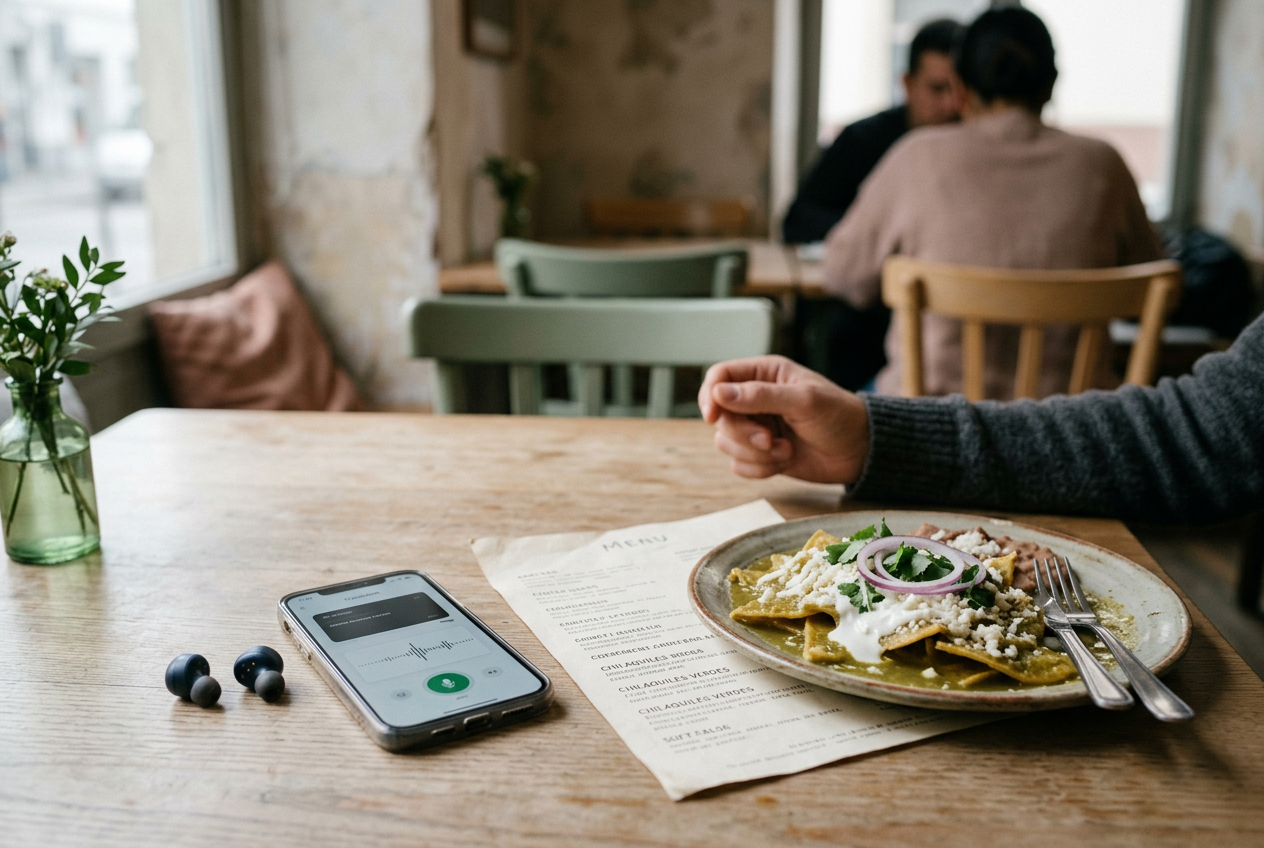
The restaurant test centered on one ordinary task: ask a server what comes with the chilaquiles verdes, understand the answer, clarify an ingredient, and place the order while another person at the table is speaking. That short exchange exposes more than a quiet demonstration does because the earbuds must identify the intended voice, recognize an unfamiliar menu term, translate the sentence, and play it back before the conversation moves on.
Translation earbuds are often presented as a replacement for passing a phone between two people. That comparison holds when both speakers wait their turn and stay close to the microphones. At a restaurant table, the real comparison is less flattering: earbuds provide private translated audio, while a phone gives everyone a visible, correctable record of what the system thinks it heard.
The distinction matters before buying. Earbuds are useful when two people expect to talk for several minutes and can tolerate a structured rhythm. They are a poor default for a quick order involving a server, another diner, and a menu full of words the speech recognizer may never have encountered.
The translation starts before the translation
A typical system does not convert sound directly into another language. It first captures speech through the earbud or phone microphone. Voice activity detection, which marks where speech begins and ends, decides when the speaker has finished. Speech recognition turns the captured audio into text, a translation model converts that text, and text-to-speech generates the audio heard by the other person.
Each stage can introduce a different error. Background music may confuse the speech boundary. Recognition can turn chilaquiles into a familiar English word or discard it as noise. The translation model may rewrite a phrase that should have remained unchanged, while the synthetic voice can make the resulting sentence sound more confident than the underlying transcript deserves.
That sequence also explains why restaurant performance cannot be judged only by whether the final sentence is broadly understandable. A system might translate the server’s explanation correctly but start playback after someone else has asked a follow-up, leaving the earbud wearer listening to an answer while the live conversation continues around them.
Setup changes the result. Some earbuds use a split arrangement in which each participant wears one bud. Others keep both buds with the owner and use the phone as the other person’s microphone and speaker. The split mode can capture each voice more closely, but asking a server to wear a shared earbud is rarely practical or hygienic.
The phone-assisted mode is easier to introduce, though it also weakens the main claim that earbuds remove the phone from the interaction.
Cross-talk breaks the turn structure
The chilaquiles verdes exchange worked best as a sequence of deliberate turns: one person speaks, pauses, and waits for translated playback before the next person begins. A restaurant does not reliably cooperate with that structure. A companion may add a question while the server is answering, or a nearby table may produce speech loud enough to compete with the intended speaker.
The hard problem is not volume alone. It is attribution. Speaker separation, sometimes called diarization, assigns speech to different people, but consumer translation hardware also needs to decide which of those people should be translated. A nearby voice can be clearer to the phone microphone than the server leaning across the table, particularly when the device sits flat beside plates and glasses.
Once two voices overlap, the result is often more disruptive than a plainly missed word. The recognizer may combine fragments from both speakers into one sentence, or voice activity detection may treat the interruption as evidence that the turn has ended. Translation then begins with an incomplete clause. By the time the missing portion arrives, the device has already committed to an interpretation.
A human listener can use the menu, pointing, and the direction of a speaker’s gaze to recover from that interruption. Earbuds receive a narrower set of signals. Products that rely mainly on audio have little access to the visual context that makes “Does that come with beans?” easy for the table to understand.
This is where daily use diverges from the feature list. Support for a language pair says that the models can process those languages. It does not say that the device can preserve turns when several people share the same acoustic space.
Menu names need different handling
Menu terms are unusually difficult because many should be copied rather than translated. Chilaquiles verdes is a name, yet the surrounding sentence may be in English, Spanish, or a mixture of both. That switch within one utterance is code-switching, and it forces the recognizer to decide whether the unfamiliar sound belongs to the active language or should remain as spoken.
The problem extends beyond pronunciation. A diner may say the English description while pointing to the Spanish name. A server may shorten the dish, mention a regional ingredient, or answer with a brand name. General speech models tend to favor common words, so a rare proper noun can be replaced by a more probable phrase that sounds similar.
Earbuds make this error harder to inspect. The translated audio arrives in the ear and disappears, unless the companion app also shows a transcript. If the system substitutes the wrong dish name but produces fluent speech, the wearer may not realize which part failed.
The phone has a practical advantage here. Place it beside the menu, show the recognized text, and let the server point to or correct the disputed term. Camera translation can also help with printed descriptions, although stylized type, glare, and mixed-language layouts still cause mistakes. Typing the exact menu name is slower than speaking it once, but faster than repeating it through an audio system that keeps normalizing it into the wrong word.
For the chilaquiles verdes order, the safest division of labor is straightforward: use speech translation for the descriptive sentence, and preserve the dish name in text where both people can see it. Earbuds alone do not offer that shared reference.
The pause is part of the product
Translation latency is the delay between speech and usable output. It comes from waiting for the end of the turn, moving audio to a phone or cloud service where required, running recognition and translation, then generating playback. A fast network can reduce one part of that chain, but it cannot remove the need to decide that the speaker has stopped.
At the table, the most noticeable delay was not a single long wait. It was the repeated pause after each utterance. The server finishes, the earbud wearer waits, the translation plays, and the reply must then travel through the same sequence in reverse. A short clarification becomes a staged exchange, which is workable when both people understand the arrangement and awkward when the server is handling several tables.
Streaming translation can begin before the sentence ends, reducing the apparent wait. It also carries a tradeoff: languages place key information in different positions, so an early translation may need to guess before the full clause arrives. Waiting produces a better chance of preserving meaning. Starting early feels more conversational but can commit the system to the wrong structure.
Background music adds pressure at the first stage. If voice activity detection cannot find a clean ending, playback begins late. If it closes the turn too aggressively, the last words disappear. Raising the speaker’s volume may improve capture, but that defeats the discretion that makes earbuds attractive in public.
The phone still wins the short exchange
A phone is usually the faster tool when the interaction is brief, public, or shared. Its screen can display both languages at once, which lets a server verify the recognized sentence before relying on the translation. Speaker mode also keeps the exchange accessible to another diner without requiring anyone to share an earbud.
Text input is the stronger fallback for names, allergies, and exact modifiers. Those are cases where a plausible translation is not enough; the user needs to inspect the source text and confirm that “without” did not become “with,” or that the system did not replace an ingredient with a similar-sounding word. This is not a claim that phone translation is inherently more accurate. The screen makes errors easier to catch.
Earbuds regain the advantage during a longer one-to-one conversation. Private playback reduces the need to hold a phone between speakers, and a close microphone can capture the wearer more consistently than a handset resting on the table. The experience improves once both participants adopt the rhythm: speak in complete thoughts, avoid interruptions, and leave room for playback.
Before relying on them, download offline language support if the product offers it, check whether translation requires a cloud connection, and confirm where transcripts are stored. Offline processing can keep working through weak restaurant reception and may limit how much audio leaves the device, though available languages and model quality vary by product. Cloud processing may handle broader language support but turns poor connectivity into another source of delay.
The buying decision is therefore narrow. Translation earbuds are worth considering for recurring conversations with one person who is willing to follow a turn-taking routine. They are not yet a clean replacement for the phone during a busy restaurant order. Keep the phone unlocked, open the transcript view, and type chilaquiles verdes before asking the earbuds to explain everything around it.
Questions people ask
Do translation earbuds work in noisy restaurants?
They can work when the intended speaker is close, background sound remains steady, and people take turns. Performance becomes less dependable when nearby speech overlaps with the conversation because the system must identify both the words and the person it should translate. Music can also delay or prematurely end speech capture.
Why do translation earbuds pause before playing audio?
The device must detect the end of the speaker’s turn, recognize the words, translate the resulting text, and generate audio. Products may run some stages on the phone, in the earbuds, or in the cloud. Starting playback earlier reduces waiting but increases the chance of translating before the sentence supplies enough context.
Are translation earbuds better than a phone for ordering food?
Usually not for a short order. A phone lets the server and diners inspect the same transcript, correct a menu name, or type an exact ingredient. Earbuds become more useful during a longer one-to-one conversation where private playback and hands-free listening outweigh the delay between turns.
Should
I share one earbud with the other speaker?
Only if both people are comfortable with the hygiene and setup. Sharing can place a microphone close to each speaker, but it is impractical with restaurant staff and unfamiliar people. Using the phone as the second microphone is easier to explain, although that means the phone remains part of the workflow.
One story a day
The story of the day, in your inbox
One real story about AI each morning — no hype, no alarm, just company for the road.